Law of Large Numbers
In this section, we present our first main result: the law of large numbers. We will discuss two versions of the law: the weak law and the strong law. We will also introduce two forms of convergence: convergence in probability and almost sure convergence.
6.3.1Sample average
The law of large numbers is a probabilistic statement about the sample average. Suppose that we have a collection of i.i.d. random variables \(X_1,\ldots,X_N\). The sample average of these \(N\) random variables is defined as follows:
The sample average of a sequence of random variables \(X_1,\ldots,X_N\) is
If the random variables \(X_1,\ldots,X_N\) are i.i.d. so that they have the same population mean \(\E[X_n] = \mu\) (for \(n = 1,\ldots,N\)), then by the linearity of the expectation,
Therefore, the mean of \(\overline{X}_N\) is the population mean \(\mu\).
The sample average, \(\overline{X}_N\), plays an important role in statistics. For example, by surveying 10,000 Americans, we can find a sample average of their ages. Since we never have access to the true population mean, the sample average is an estimate, and since \(\overline{X}_N\) is only an estimate, we need to ask how good the estimate is.
One reason we ask this question is that \(\overline{X}_N\) is a finite-sample “approximation” of \(\mu\). More importantly, the root of the problem is that \(\overline{X}_N\) itself is a random variable because \(X_1, \ldots, X_N\) are all random variables. Since \(\overline{X}_N\) is a random variable, there is a PDF of \(\overline{X}_N\); there is a CDF of \(\overline{X}_N\); there is \(\E[\overline{X}_N]\); and there is \(\Var[\overline{X}_N]\). Since \(\overline{X}_N\) is a random variable, it has uncertainty. To say that we are confident about \(\overline{X}_N\), we need to ensure that the uncertainty is within some tolerable range.
How do we control the uncertainty? We can compute the variance. If \(X_1,\ldots,X_N\) are i.i.d. random variables with the same variance \(\Var[X_n] = \sigma^2\) (for \(n = 1,\ldots, N\)), then
Therefore, the variance will shrink to 0 as \(N\) grows. In other words, the more samples we use to construct the sample average, the less deviation the random variable \(\overline{X}_N\) will have.
Visualizing the sample average
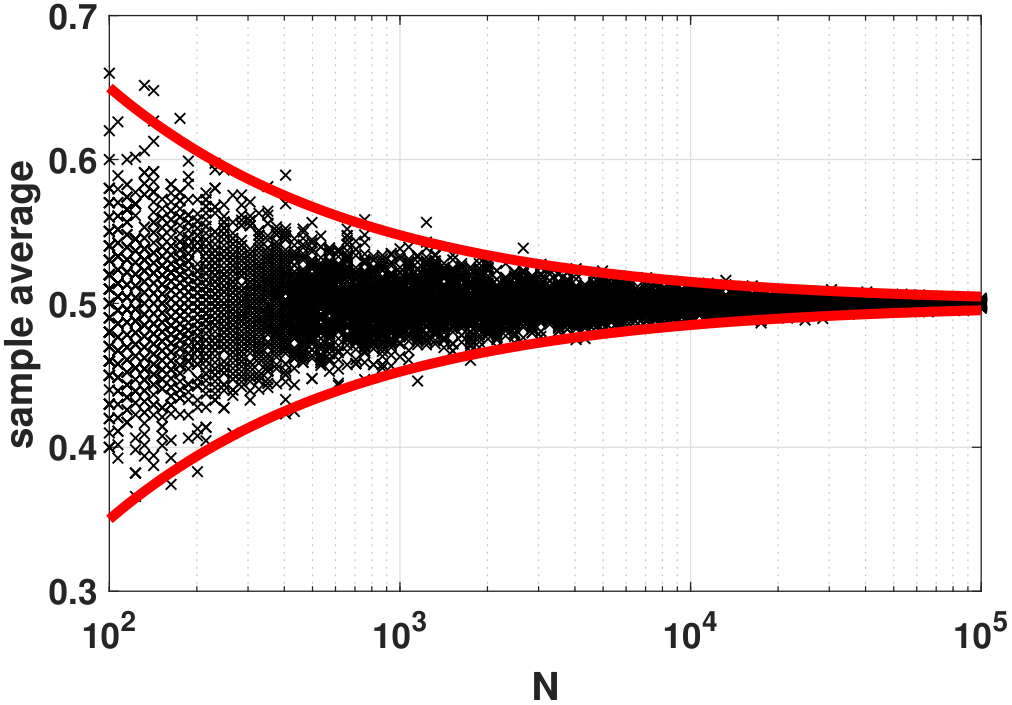
To help you visualize the randomness of \(\overline{X}_N\), we consider an experiment of drawing \(N\) Bernoulli random variables \(X_1,\ldots,X_N\) with parameter \(p = 1/2\). Since \(X_n\) is Bernoulli, it follows that
We construct a sample average \(\overline{X}_N = \frac{1}{N}\sum_{n=1}^N X_n\). Since \(X_n\) is a Bernoulli random variable, we know everything about \(\overline{X}_N\). First, \(N\overline{X}_N = \sum_{n=1}^N X_n\) is a binomial random variable, so \(\overline{X}_N\) is a scaled binomial taking values in \(\{0,\frac1N,\ldots,1\}\). Second, the mean and variance of \(\overline{X}_N\) are respectively
In Figure 6.10, we plot the random variables \(\overline{X}_N\) (the black crosses) for every \(N\). You can see that at each \(N\), e.g., \(N = 100\), there are many possible observations for \(\overline{X}_N\) because \(\overline{X}_N\) itself is a random variable. As \(N\) increases, we see that the deviation of the random variables becomes smaller. In the same plot, we show the bounds \(\mu \pm 3\sigma_{\overline{X}_N}\), which are three standard deviations from the mean. We can see clearly that the bounds provide a very good envelope covering the random variables. As \(N\) goes to infinity, we can see that the standard deviation goes to zero, and so \(\overline{X}_N\) approaches the true mean.
For your reference, the MATLAB code and the Python code we used to generate the plot are shown below.
% MATLAB code to illustrate the weak law of large numbers
    Nset = round(logspace(2,5,100));
    for i=1:length(Nset)
        N = Nset(i);
        p = 0.5;
        x(:,i) = binornd(N, p, 1000,1)/N;
    end
    y = x(1:10:end,:)';
    semilogx(Nset, y, 'kx'); hold on;
    semilogx(Nset, p+3*sqrt(p*(1-p)./Nset), 'r', 'LineWidth', 4);
semilogx(Nset, p-3*sqrt(p*(1-p)./Nset), 'r', 'LineWidth', 4);# Python code to illustrate the weak law of large numbers
import numpy as np
import matplotlib.pyplot as plt
import scipy.stats as stats
p = 0.5
Nset = np.round(np.logspace(2,5,100)).astype(int)
x = np.zeros((1000,Nset.size))
for i in range(Nset.size):
N = Nset[i]
x[:,i] = stats.binom.rvs(N, p, size=1000)/N
Nset_grid = np.broadcast_to(Nset, (1000, Nset.size))
plt.semilogx(Nset_grid, x,'ko');
plt.semilogx(Nset, p + 3*np.sqrt((p*(1-p))/Nset), 'r', linewidth=6)
plt.semilogx(Nset, p - 3*np.sqrt((p*(1-p))/Nset), 'r', linewidth=6)Note the outliers for each \(N\) in Figure 6.10. For example, at \(N = 10^2\) we see a point located near 0.7 on the \(y\)-axis. This point is outside three standard deviations. Is it normal? Yes. Being outside three standard deviations only says that the probability of having this outlier is small. It does not say that the outlier is impossible. Having a small probability does not exclude the possibility. By contrast, if you say that something will surely not happen you mean that there is not even a small probability. The former is a weaker statement than the latter. Therefore, even though we establish a three standard deviation envelope, there are points falling outside the envelope. As \(N\) grows, the chance of having a bad outlier becomes smaller. Therefore, the greater the \(N\), the smaller the chance we will get an outlier.
If the random variables \(X_n\) are i.i.d., the above phenomenon is universal. Below is an example of the Poisson case.
Let \(X_n \sim \text{Poisson}(\lambda)\). Define the sample average as \(\overline{X}_N = \frac{1}{N} \sum_{n=1}^N X_n\). Find the mean and variance of \(\overline{X}_N\).
Since \(X_n\) is Poisson, we know that \(\E[X_n] = \lambda\) and \(\Var[X_n] = \lambda\). So
Therefore, as \(N \rightarrow \infty\), the variance \(\Var[\overline{X}_N] \rightarrow 0\).
6.3.2Weak law of large numbers (WLLN)
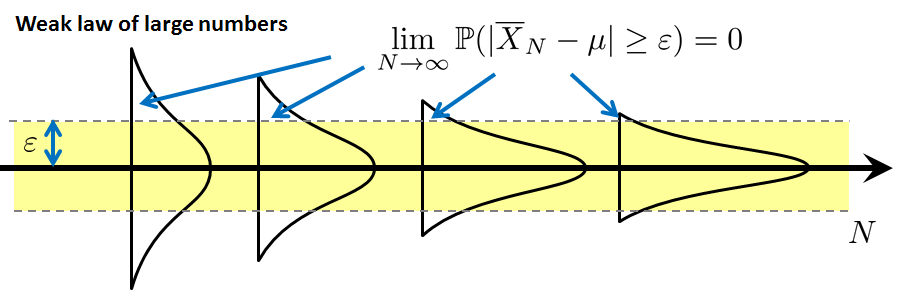
The analysis of Figure 6.10 shows us something important, namely that the convergence in a probabilistic way is different from that in a deterministic way. We now describe one fundamental result related to probabilistic convergence, known as the weak law of large numbers.
Let \(X_1,\ldots,X_N\) be a set of i.i.d. random variables with mean \(\mu\) and finite variance \(\sigma^2\), i.e., \(\E[X_n^2] < \infty\). Let \(\overline{X}_N = \frac{1}{N} \sum_{n=1}^N X_n\). Then for any \(\varepsilon > 0\),
Proof. By Chebyshev's inequality,
Therefore, setting \(N \rightarrow \infty\) we have
Consider a set of i.i.d. random variables \(X_1,\ldots,X_N\) where $$X_n \sim \text{Gaussian}(\mu,\sigma^2).$$ Verify that the sample average \(\overline{X}_N = \frac{1}{N} \sum_{n=1}^N X_n\) follows the weak law of large numbers.
: Since \(X_n\) is a Gaussian, the sample average \(\overline{X}_N\) is also a Gaussian:
Consider the probability \(\Pb\left[ |\overline{X}_N - \mu| > \varepsilon \right]\) for each \(N\):
If we set \(\sigma = 1\) and \(\varepsilon = 0.1\), then
As you can see, the sequence \(\delta_1,\delta_2,\ldots,\delta_N,\ldots\) rapidly converges to 0 as \(N\) grows. In fact, since \(\Phi(z)\) is an increasing function for \(z< 0\) with \(\Phi(-\infty) = 0\), it follows that
The weak law of large numbers is portrayed graphically in Figure 6.11. In this figure we draw several PDFs of the sample average \(\overline{X}_N\). The shapes of the PDFs are getting narrower as the variance of the random variable shrinks. Since the PDFs become narrower, the probability \(\Pb[|\overline{X}_N-\mu| > \varepsilon]\) becomes more unlikely. At the limit when \(N \rightarrow \infty\), the probability vanishes. The weak law of large numbers asserts that this happens for any set of i.i.d. random variables. It says that the sequence of probability values \(\delta_N \bydef \Pb[|\overline{X}_N-\mu| > \varepsilon]\) will converge to zero.
Let \(\overline{X}_N\) be the sample average of i.i.d. random variables \(X_1,\ldots,X_N\).
- sep0ex
- For details, see Theorem thm: ch6 WLLN.
- The WLLN concerns the sequence of probability values \(\delta_N = \Pb[ |\overline{X}_N - \mu| > \varepsilon]\).
- The probabilities converge to zero as \(N\) grows.
- It is weak because having a small probability does not exclude the possibility of happening.
6.3.3Convergence in probability
The example above tells us that in order to show convergence, we need to first compute the probability \(\delta_n\) of each event and then take the limit of the sequence, e.g., the one shown in the table below:
| \(\delta_1\) | \(\delta_5\) | \(\delta_{10}\) | \(\delta_{100}\) | \(\delta_{1000}\) | \(\delta_{10000}\) |
| 0.9203 | 0.8231 | 0.7518 | 0.3173 | 0.0016 | 1.5240\(\times 10^{-23}\) |
Therefore, the convergence is the convergence of the probability. Since \(\{\delta_1,\delta_2,\ldots\}\) is a sequence of real numbers (between 0 and 1), any convergence results for real numbers apply here.
Note that the convergence controls only the probabilities. Probability means chance. Therefore, having the limit converging to zero only means that the chance of happening is becoming smaller and smaller. However, at any \(N\), there is still a chance that some bad event can happen.
What do we mean by a bad event? Assume that \(X_n\) are fair coins. The sample average \(\overline{X}_N = (1/N)\sum_{n=1}^N X_n\) is more or less equal to 1/2 as \(N\) grows. However, even if \(N\) is a large number, say \(N = 1000\), we are still not certain that the sample average is exactly 1/2. It is possible, though very unlikely, that we obtain \(1000\) heads or \(1000\) tails (so that the sample average is “1” or “0”). The bottom line is: Having a probability converging to zero only means that for any tolerance level we can always find an \(N\) large enough so that the probability is smaller than that tolerance.
The type of convergence described by the weak law of large numbers is known as the convergence in probability.
A sequence of random variables \(A_1,\ldots,A_N\) converges in probability to a deterministic number \(\alpha\) if for every \(\varepsilon > 0\),
We write \(A_N \overset{p}{\rightarrow} \alpha\) to denote convergence in probability.
The following two examples illustrate how to prove convergence in probability.
Let \(X_1,\ldots,X_N\) be i.i.d. random variables with \(X_n \sim \text{Uniform}(0,1)\). Define \(A_N = \min(X_1,\ldots,X_N)\). Show that \(A_N\) converges in probability to zero.
(Without determining the PDF of \(A_N\), we notice that as \(N\) increases, the value of \(A_N\) will likely decrease. Therefore, we should expect \(A_N\) to converge to zero.) Pick an \(\varepsilon > 0\). It follows that
Setting the limit of \(N\rightarrow \infty\), we conclude that
Therefore, \(A_N\) converges to zero in probability.
Let \(X \sim \text{Exponential}(1)\). By evaluating the CDF, we know that \(\Pb[X \ge x] = e^{-x}\). Let \(A_N = X/N\). Prove that \(A_N\) converges to zero in probability.
For any \(\varepsilon>0\),
Putting \(N \rightarrow \infty\) on both sides of the equation gives us
Thus, \(A_N\) converges to zero in probability.
Construct an example such that \(A_N\) converges in probability to something, but \(\E[A_N]\) does not converge to the same thing.
Consider a sequence of random variables \(A_N\) such that
The PDF of the random variable \(A_N\) is shown in Figure 6.12.
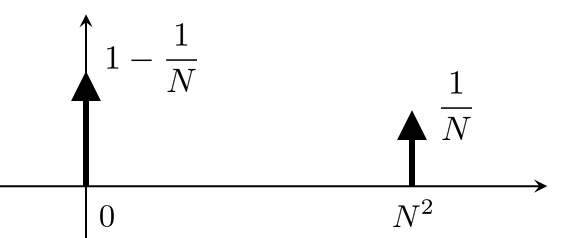
We first show that \(A_N\) converges in probability to zero. Let \(\varepsilon> 0\) be a fixed constant. Since \(\varepsilon> 0\),
for any \(N > \sqrt{\varepsilon}\). Therefore, we have that
Hence, \(A_N\) converges to 0 in probability.
However, \(\E[A_N]\) does not converge to zero, because
So \(\E[A_N]\) goes to infinity as \(N\) grows.
6.3.4Can we prove WLLN using Chernoff's bound?
The following discussion of using Chernoff's bound to prove WLLN can be skipped if this is your first time reading the book.
In proving WLLN we use Chebyshev's inequality. Can we use Chernoff's inequality (or Hoeffding's) to prove the result? Yes, we can use them. However, notice that the task here is to prove convergence, not to find the best convergence. Finding the best convergence means finding the fastest decay rate of the probability sequence. Chernoff's bound (and Hoeffding's inequality) offers a better decay rate. However, Chernoff's bound needs to be customized for individual random variables. For example, Chernoff's bound for Gaussian is different from Chernoff's bound for exponential. This result makes Chebyshev the most convenient bound because it only requires the variance to be bounded.
What if we insist on using Chernoff's bound in proving the WLLN? We can do that for specific random variables. Let's consider two examples. The first example is the Gaussian random variable where \(X_n \sim \text{Gaussian}(0,\sigma^2)\). We know that \(\overline{X}_N \sim \text{Gaussian}(0, \sigma^2/N)\). Chernoff's bound shows that
Taking the limit on both sides, we have
Note that the rate of convergence here is exponential. The rate of convergence offered by Chebyshev is only linear. Of course, you may argue that since \(X_n\) is Gaussian we have closed-form expressions about the probability, so we do not need Chernoff's bound. This is a legitimate point, and so here is an example where we do not have a closed-form expression for the probability.
Consider a sequence of arbitrary i.i.d. random variables \(X_1,\ldots,X_N\) with \(0 \le X_n \le 1\). Then Hoeffding's inequality tells us that
Taking the limit on both sides, we have
Again, we obtain a WLLN result, this time for i.i.d. random variables \(X_1,\ldots,X_N\) with \(0 \le X_n \le 1\).
As you can see from these two examples, WLLN can be proved in multiple ways depending on how general the random variables need to be.
End of the discussions.
6.3.5Does the weak law of large numbers always hold?
The following discussion of the failure of the weak law of large numbers can be skipped if this is your first time reading the book.
The weak law of large numbers does not always hold. Recall that when we prove the weak law of large numbers using Chebyshev's inequality, we implicitly require that the variance \(\Var[\overline{X}_N]\) is finite. (Look at the condition that \(\E[X^2] < \infty\).) Thus for distributions whose variance is unbounded, Chebyshev's inequality does not hold. One example is the Cauchy distribution. The PDF of a Cauchy distribution is
where \(\gamma\) is a parameter. Letting \(\gamma = 1\),
Since the second moment is unbounded, the variance of \(X\) will also be unbounded.
A perceptive reader may observe that even if \(\E[X^2]\) is unbounded, it does not mean that the tail probability is unbounded. This is correct. However, for Cauchy distributions, we can show that the sample average \(\overline{X}_N\) does not converge to the mean when \(N \rightarrow \infty\) (and so the WLLN fails). To see this, we note that
So for the sample average \(\overline{X}_N = \frac{1}{N}\sum_{n=1}^N X_n\), the characteristic function is
which remains a Cauchy distribution with \(\gamma = 1\). Therefore, we have that
Thus no matter how many samples we have, \(\Pb[|\overline{X}_N| \le \varepsilon]\) will never converge to 1 (so \(\Pb[|\overline{X}_N| > \varepsilon]\) will never converge to 0). Therefore, WLLN does not hold.
End of the discussion.
6.3.6Strong law of large numbers
Since there is a “weak” law of large numbers, you will not be surprised to learn that there is a strong law of large numbers. The strong law is more restrictive than the weak law. Any sequence satisfying the strong law will satisfy the weak law, but not vice versa. Since the strong law is “stronger”, the proof is more involved.
Let \(X_1,\ldots,X_N\) be a sequence of i.i.d. random variables with common mean \(\mu\) and variance \(\sigma^2\). Assume \(\E[X_n^4] < \infty\). Let \(\overline{X}_N = \frac{1}{N} \sum_{n=1}^N X_n\) be the sample average. Then
The strong law flips the order of limit and probability. As you can see, the difference between the strong law and the weak law is the order of the limit and the probability. In the weak law, the limit is outside the probability, whereas, in the strong law, the limit is inside the probability. This switch in order makes the interpretation of the result fundamentally different. In the final analysis, the weak law concerns the limit of a sequence of probabilities (which are just real numbers between 0 and 1). However, the strong law concerns the limit of a sequence of random variables. The strong law answers the question, what is the limiting object of the sample average as \(N\) grows?
The strong law concerns the limiting object, not a sequence of numbers. What is the “limiting object”? If we denote \(\overline{X}_N\) as the sample average using \(N\) samples, then we know that \(\overline{X}_1\) is a random variable, \(\overline{X}_2\) is a random variable, and all \(\overline{X}_n\)'s are random variables. So we have a sequence of random variables. As \(N\) goes to infinity, we can ask about the limiting object \(\lim_{N\rightarrow \infty}\overline{X}_N\). However, even without any deep analysis, you should be able to see that \(\lim_{N\rightarrow \infty}\overline{X}_N\) is another random variable. The strong law says that this limiting object will “successfully” become a deterministic number \(\mu\), after a finite number of “failures”.
The strong law asserts that there are a finite number of failures. Let us explain “success” and “failure”. Fix any tolerance \(\epsilon > 0\) and call it a failure whenever \(|\overline{X}_N - \mu| > \epsilon\). \(\overline{X}_N\) is a random variable, so it fluctuates and failures do occur. The strong law says that, with probability 1, only finitely many of these failures ever happen: there is some (random) index \(N_0\) beyond which \(|\overline{X}_N - \mu| \le \epsilon\) for every \(N \ge N_0\). Note that this does not say that \(\overline{X}_N\) ever becomes exactly equal to \(\mu\) — for a continuous distribution \(\Pb[\overline{X}_N = \mu] = 0\) for every \(N\). What it says is that the whole sequence settles inside any tolerance band you name, and stays there. That is a 100% guarantee about the sequence. The weak law only guarantees that each individual \(\Pb[|\overline{X}_N - \mu| > \epsilon]\) becomes small.
A good example for differentiating the weak law and the strong law is an electronic dictionary that improves itself every time you use it. The weak law says that if you use the dictionary for a long period, the probability of making an error will become small. You will still get an error once in a while, but the probability is very small. This is a 99.99% guarantee, and it is the weak law. The strong law says that the number of failures is finite. After you have gone through this finite number of failures, you will be completely free of error. This is a 100% guarantee by the strong law. When will you hit this magical number? The strong law does not say when; it only asserts the existence of this number. However, this existence is already good enough in many ways. It gives a certificate of assurance, whereas the weak law still has uncertainty.
Strong law \(\not=\) deterministic. If the strong law offers a 100% guarantee, does it mean that it is a deterministic guarantee? No, the strong law is still a probabilistic statement because we are still using \(\Pb[\cdot]\) to measure an event. The event can include measure-zero subsets, and the measure-zero subsets can be huge. For example, the set of rational numbers on the real line is a measure-zero set when measuring the probability using an integration. The strong law does not handle those measure-zero subsets.
6.3.7Almost sure convergence
The discussion below can be skipped if this is your first time reading the book.
The type of convergence used by the strong law of large numbers is the almost sure convergence. It is defined formally as follows.
A sequence of random variables \(A_1,\ldots,A_N\) converges almost surely to \(\alpha\) if
We write \(A_N \overset{a.s.}{\rightarrow} \alpha\) to denote almost sure convergence.
To prove almost sure convergence, one needs to show that, with probability 1, the sequence of numbers \(A_1(\xi), A_2(\xi), \ldots\) converges to \(\alpha\) in the ordinary sense of calculus: for every \(\epsilon > 0\) there are only finitely many \(N\) with \(|A_N - \alpha| > \epsilon\).
(This example is modified from Bertsekas and Tsitsiklis, Introduction to Probability, Chapter 5.5.) Construct a sequence of events that converges almost surely.
Let \(X_1,\ldots,X_N\) be i.i.d. random variables such that \(X_n \sim \text{Uniform}(0,1)\). Define \(A_N = \min(X_1,\ldots,X_N)\). Since \(A_N\) is nonincreasing and is bounded below by zero, it must have a limit. Let us call this limit
Then we can show that
where \((a)\) holds because there are more elements in \((X_1,X_2,\ldots)\) than in \((X_1,X_2,\ldots,X_N)\). Therefore, the minimum value of the former is less than the minimum value of the latter. \((b)\) holds because if \(\min(X_1,X_2,\ldots,X_N) \ge \epsilon\), then \(X_n \ge \epsilon\) for all \(n\).
Since \(\Pb[A \ge \epsilon] \le (1-\epsilon)^N\) for any \(N\), the statement still holds as \(N \rightarrow \infty\). Thus,
This shows \(\Pb[A \ge \epsilon] = 0\) for any positive \(\epsilon\). So \(\Pb[A > 0] = 0\), and hence \(\Pb[A = 0]= 1\). Since \(A\) is the limit of \(A_N\), we conclude that
So \(A_N\) converges to 0 almost surely.
(This example is modified from Bertsekas and Tsitsiklis, Introduction to Probability, Chapter 5.5.) Construct an example where a sequence of events converges in probability but does not converge almost surely.
Consider a discrete time arrival process. The set of times is partitioned into consecutive intervals of the form
Therefore, the length of each interval is \(|I_1| = 2\), \(|I_2| = 4\), …, \(|I_k| = 2^k\).
During each interval, there is exactly one arrival. Define \(Y_n\) as a binary random variable such that for every \(n \in I_k\),
For example, if \(n \in \{2,3\}\), then \(\Pb[Y_n = 1] = \frac{1}{2}\). If \(n \in \{4,5,6,7\}\), then \(\Pb[Y_n = 1] = \frac{1}{4}\). In general, we have that
and hence
Therefore, \(Y_n\) converges to 0 in probability.
However, when we carry out the experiment, there is exactly one arrival per interval according to the problem conditions. Since we have an infinite number of intervals \(I_1,I_2,\ldots\), we will have an infinite number of arrivals in total. As a result, \(Y_n = 1\) infinitely often. We do not know which \(Y_n\) will equal 1 and which \(Y_n\) will equal 0. However, we know that there are infinitely many \(Y_n\) that are equal to 1 — and, since each interval \(I_k\) has length \(2^k \ge 2\), also infinitely many \(Y_n\) that are equal to 0.
This is exactly what breaks the almost sure convergence. A sequence of numbers that contains infinitely many 1's and infinitely many 0's does not converge at all: no matter how far out you go, you can still find a later 1 and a later 0. So for (almost) every realization the limit \(\lim_{n\rightarrow\infty} Y_n\) does not exist, and in particular
Therefore, \(Y_n\) converges to 0 in probability but not almost surely.
End of the discussions.
6.3.8Proof of the strong law of large numbers
The strong law of large numbers can be proved in several ways. We present a proof based on Bertsekas and Tsitsiklis, Introduction to Probability, Problems 5.16 and 5.17, which require a finite fourth moment \(\E[X_n^4] < \infty\). An alternative proof that requires only \(\E[X_n] < \infty\) is from Billingsley, Probability and Measure, Theorem 22.1.
The proof of the strong law of large numbers is beyond the scope of this book. This section is optional.
Consider non-negative random variables \(X_1,\ldots,X_N\). Assume that
Then \(X_n \overset{a.s.}{\rightarrow} 0\).
Proof. Let \(S = \sum_{n=1}^\infty X_n\). Note that \(S\) is a random variable, and our assumption is that \(\E[S] < \infty\). Thus, we argue that \(S < \infty\) with probability 1. If not, then \(S\) will have a positive probability of being \(\infty\). But if this happens, we will have \(\E[S] = \infty\) because (by the law of total expectation): $$\E[S] = \underset{=\infty}{\underbrace{\E[S \;|\; S = \text{infinite}]}}\Pb[S = \text{infinite}] + \E[S \;|\; S = \text{finite}]\Pb[S = \text{finite}].$$
Now, since \(S\) is finite, the sequence \(\{X_1,\ldots,X_N,\ldots\}\) must converge to zero. Otherwise, if \(X_n\) is converging to some constant \(c > 0\), then summing the tail of the sequence (which contains infinitely many terms) gives infinity:
Since the probability of \(S\) being finite is 1, it follows that \(\{X_1,\ldots,X_N,\ldots\}\) is converging to zero with probability 1.
■Let \(X_1,\ldots,X_N\) be a sequence of i.i.d. random variables with common mean \(\mu\) and variance \(\sigma^2\). Assume \(\E[X_n^4] < \infty\). Let \(\overline{X}_N = \frac{1}{N} \sum_{n=1}^N X_n\) be the sample average. Then
Proof. We first prove the case where \(\E[X_n] = 0\). To establish that \(\overline{X}_N \rightarrow 0\) with probability 1, we use the lemma to show that $$\E\left[\sum_{N=1}^{\infty}|\overline{X}_N|\right] < \infty.$$ But to show \(\E[\sum_{N=1}^{\infty}|\overline{X}_N|] < \infty\), we note that \(|x| \le 1+x^4\). Therefore, \(\E[\sum_{N=1}^{\infty}|\overline{X}_N|] \le 1 + \E[\sum_{N=1}^{\infty} \overline{X}_N^4]\), and hence we just need to show that $$\E\left[\sum_{N=1}^{\infty} \overline{X}_N^4\right] < \infty.$$
Let us expand the term \(\E[\overline{X}_N^4]\) as follows:
There are five possibilities for \(\E[X_{n_1}X_{n_2}X_{n_3}X_{n_4}]\):
- sep0ex
All indices are different. Then
$$\E[X_{n_1}X_{n_2}X_{n_3}X_{n_4}] = \E[X_{n_1}]\E[X_{n_2}] \E[X_{n_3}]\E[X_{n_4}] = 0 \cdot 0 \cdot 0 \cdot 0 = 0.$$One index is different from other three indices. For example, if \(n_1\) is different from \(n_2,n_3,n_4\), then
$$\E[X_{n_1}X_{n_2}X_{n_3}X_{n_4}] = \E[X_{n_1}]\E[X_{n_2}X_{n_3}X_{n_4}] = 0 \cdot \E[X_{n_2}X_{n_3}X_{n_4}] = 0.$$Two indices are identical. For example, if \(n_1 = n_3\), and \(n_2 = n_4\), then
$$\E[X_{n_1}X_{n_2}X_{n_3}X_{n_4}] = \E[X_{n_1}X_{n_3}] \E[X_{n_2}X_{n_4}] = \E[X_{n_1}^2X_{n_2}^2].$$There are altogether \(3N(N-1)\) of these cases: \(N(N-1)\) comes from choosing \(N\) followed by choosing \(N-1\), and 3 accounts for \(n_1=n_2 \not= n_3 = n_4\), \(n_1=n_3 \not= n_2 = n_4\), and \(n_1=n_4 \not= n_2 = n_3\).
Two indices are identical, and two indices are different. For example, if \(n_1 = n_3\) but \(n_2\) and \(n_4\) are different. Then
$$\begin{aligned} \E[X_{n_1}X_{n_2}X_{n_3}X_{n_4}] &= \E[X_{n_1}X_{n_3}] \E[X_{n_2}]\E[X_{n_4}] \\ &= \E[X_{n_1}^2] \cdot 0 \cdot 0 = 0. \end{aligned}$$All indices are identical. If \(n_1 = n_2 = n_3 = n_4\), then
$$\E[X_{n_1}X_{n_2}X_{n_3}X_{n_4}] = \E[X_{n_1}^4].$$There are altogether \(N\) cases of this.
Therefore, it follows that
Since \(xy \le (x^2+y^2)/2\), it follows that
Substituting into the previous result,
Now, let us complete the proof.
because \(\sum_{N=1}^\infty (1/N^2)\) is the Basel problem with a solution that \(\sum_{N=1}^\infty (1/N^2) = \pi^2/6\). Consequently, we have shown that \(\E\left[\sum_{N=1}^{\infty} \overline{X}_N^4\right] < \infty\), which implies \(\E\left[\sum_{N=1}^{\infty}|\overline{X}_N|\right] < \infty\). Then, by the lemma, we have \(\overline{X}_N\) converging to 0 with probability 1, which proves the result.
If \(\E[X_n] = \mu\), then just replace \(X_n\) with \(Y_n = X_n - \mu\) in the above arguments. Then we can show that \(\overline{Y}_N\) converges to 0 with probability 1, which is equivalent to \(\overline{X}_N\) converging to \(\mu\) with probability 1.
■End of the proof of strong law of large numbers.